Aims and Actions
With the Community-Based Landscape Regeneration Toolkit, we identified opportunities to develop community-based approaches to landscape restoration in several areas, drawing on promising examples of community initiatives in the Cairngorms. At the same time, substantial challenges and barriers remain to enhanced community involvement and leadership in regenerating the land. Land reform is central to communities having the power to make decisions on the land and to equitable land governance in Scotland. Yet, our research identified other intersecting factors that impede community development, including limited community capacities, local democratic gaps, and a lack of social infrastructure. There are gaps in the support communities require to navigate this challenging landscape, some of which were highlighted further in our ‘community and environments’ toolkit review.
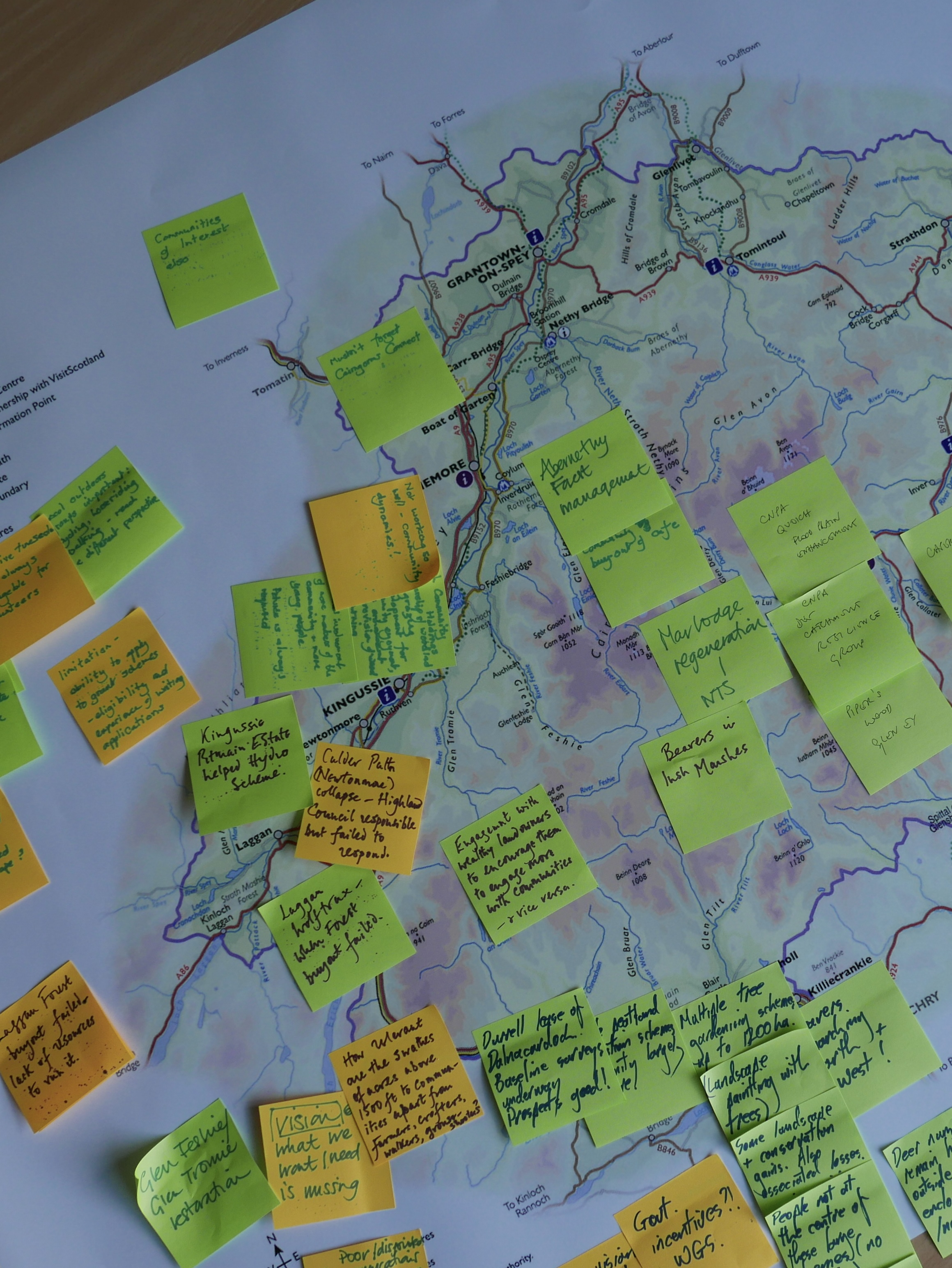
Drawing on the findings and stories, we propose aims and corresponding action points to enhance and strengthen community-based landscape regeneration. The aims and actions coalesce through co-creation workshops, interviews, site visits, and community-based peer review, which contributed to and sharpened this guidance. The aims map onto, and are organised according to, our five-part structure, connecting to the key takeaways summarised at the end of each story thematic section and arising from community input and suggestions gathered from interviews, workshops, field visits and ongoing conversations. More specifically, the action points were co-developed in a feedback workshop. These aims and action points focus on the Cairngorms area, while also providing relevance for the rest of Scotland and are applicable to a range of different stakeholders.
First, the toolkit provides aims and actions for supporting third-sector organisations and networks, NGOs, large landowners, policy bodies, elected representatives, and local, regional and national governmental organisations. The aims and actions can be used to facilitate approaches to landscape regeneration which centre and empower communities as part of democratic and inclusive land governance arrangements, and show how these groups can support that process.
Second, these aims and actions can be used by diverse communities, including but not limited to farmers, crofters, community-based organisations, community councils, development trusts, mountaineering and outdoor tourism professionals, and youth conservation groups. While some aims and actions may be outside the direct locus of community control, they can be drawn upon by community groups and community councils as campaign materials for advocating on specific issues around community and land to policy bodies, local authorities and wider supporting organisations. The aims can also be used as building blocks and supporting materials for communities to develop visions, planning or other forms of collective expression, and to guide next steps in that work.
Land ownership & control
Aim 1: Strengthen community land control
- Finding Restricted land ownership and control
- Story Transforming Land Ownership and Control through Community Woodlands
- Map See this theme on the map
Improve community support and reduce administrative burdens.
Action points
- Reform funding and support packages available to communities seeking land ownership.
- Provide tailored support to communities to overcome barriers to acquiring land or sustaining land management, particularly for those with limited capacities and resources.
- Reduce the complexity and bureaucracy of funding requirements.
Related toolkit resources
Ensure community support continues beyond the funding application stages.
Action points
- Direct increased funding and support beyond the initial stages of community-owned land to enhance the longevity of community-led approaches.
- Improve land reform funds to form part of a more holistic, long-term approach to supporting community development.
- Recognise geographical differences between communities when targeting long-term support.
Related toolkit resources
Extend land-reform policies to strengthen community land control and decision-making.
Action points
- Develop statutory components to underpin the ‘Land Rights and Responsibilities statement’.
- Introduce a ‘public interest test’ to assess whether significant land transfers demonstrably align with public interest.A land reform mechanism which has been proposed by the Scottish Land Commission, but which was not included in the Land Reform Act 2025. See: Scottish Land Commission, Review of Scale and Concentration of Land Ownership: Report to Ministers This is a form of land market regulation which our research emphasises is needed to counter the buying up of land for natural capital and carbon market speculative purposes, antithetical to community interests.
- Stop the sale of Scottish land on world markets.
- Increase accountability for landowners regarding community benefits and engagement, building on the land management plans outlined in the Land Reform Act 2025.
Related toolkit resources
Social, ecological & economic benefits
Aim 2: Align social, ecological, and economic benefits within landscape-regeneration initiatives
- Finding Landscape regeneration and socio-economic benefits
- Story Generating Social and Economic Benefits from Landscape Regeneration
- Map See this theme on the map
Connect landscape regeneration initiatives, plans, and policies to address wider social concerns, including job creation, affordable housing, public services, transport, and livelihoods.
Action points
- Extend existing work carried out on just transitions in Scotland by focusing more strongly on rural land-use change and rural employment in the green transition.
- Provide greater support for communities to lead the development of their own housing, service, and transport solutions.
Related toolkit resources
Develop guidelines for addressing conflicts between nature restoration and tourism.
Action points
- Identify possible trade-offs in the development of nature-based tourism, and outline how to manage them in a fair, sustainable way.
- Ensure stronger regulatory control of short-term lets to open avenues for affordable housing in rural communities, building on the recent Highland Council consultation on STL control.
- Support communities to benefit from tourism by developing social enterprises.
Related toolkit resources
Integrate rural skills development with landscape regeneration initiatives.
Action points
- Direct landscape regeneration initiatives and policies toward supporting the development of rural skills within communities.
- Roll out specialist courses and training centres for land-based skills in rural Scotland, ensuring they are accessible to rural communities.
- Develop educational and funding opportunities for rural skills training, particularly in sectors with current skills gaps, such as forestry and peatland restoration.
Related toolkit resources
Advance community-wealth building within economic development plans.
Action points
- Develop a community wealth-building approach to economic development in Scotland that aims to enhance the local generation and retention of economic wealth, building on the community wealth-building bill that recently passed through the Scottish Parliament.Community Wealth Building (Scotland) Act 2026.
- Where possible, ensure landscape regeneration initiatives employ and source materials locally.
- Build on decades of community-led development, including social enterprises and community land ownership.Brodie and Doyle, Community Wealth Building.
Related toolkit resources
Community capacities
Aim 3: Expand community capacities through networks, education, and resource sharing
- Finding Unequal community capacities
- Story Building Community Capacities through Community Development
- Map See this theme on the map
Provide long-term financial support for community initiatives.
Action points
- Develop stable, reliable funding over longer periods for community groups and organisations to support their work.
- Increase financial backing for community support organisations so they can build social capacities and support community resilience.
- Reform community benefits at Scottish Government level so they are fairer and more evenly distributed across the National Park, particularly by linking renewable energy community benefit funds to the Highland Council’s ‘social value charter’.
- Focus support on boosting project delivery by investing in social enterprise development.
- Support the resilience of community-based organisations.
Related toolkit resources
Provide greater support for communities to develop the skills and knowledge needed to address unequal community capacities and strengthen action.
Action points
- Identify the skills and knowledge gaps across the National Park and, in particular, within communities to target support effectively.
- Given the diversity of communities, provide tailored support packages and develop a wide range of skills and expertise, for instance through training and support for networks in funding and land acquisition applications.
- Pay community leaders to build social capacity and support community development.
Related toolkit resources
Enhance networks for knowledge exchange, collaboration, and mutual learning.
Action points
- Develop connections to existing and established community-based organisations so they can support project initiation and development.
- Strengthen the role of regional network organisations, such as climate action hubs, in supporting community-based organisations through knowledge and resource sharing, as well as access to funds.
- Conduct stakeholder mapping in the Cairngorms so communities can develop projects, identify funders and other relevant organisations and potential partners in the area, and understand the policy landscape.
Related toolkit resources
Community voice & engagement
Aim 4: Enhance community engagement in land-use decision-making
- Finding Limited community voice and influence
- Story Strengthening Community Engagement and Influence
- Map See this theme on the map
Elevate community voice and influence earlier in the development process, beyond consultation exercises.
Action points
- With landscape regeneration initiatives and policies, move away from a top-down, consultation-led system toward community-led decision-making in local areas, so communities have greater say from the earliest stages of development.
- Through land reform policies, develop more responsible forms of land governance that increase communities’ influence over land decisions and clarify how this influence should be exercised.
- Further develop and strengthen Land Management Plans, which mandate large landowners to engage with communities, to provide a standard basis for governance arrangements and participatory practices.
- Lobby the Scottish and UK governments to amplify community voice in land-use decision-making.
- Bring community-based organisations into policy spaces as representative bodies of rural communities, so their role in decision-making is clear.
- Develop clearer channels for communities to express views to the Highland Council and the Scottish government.
Related toolkit resources
Integrate diverse community perspectives and local land-management knowledge into decision-making and planning.
Action points
- Develop more long-term, meaningful forms of interaction with communities to learn about their needs and perspectives, rather than engaging only at discrete points in time.
- With landscape regeneration initiatives and plans, carry out substantial and robust engagement with diverse community perspectives and local knowledge about managing the land, and use it to shape action.
Related toolkit resources
Generate more joined-up and inclusive approaches to community participation across the full process.
Action points
- Identify which groups and sections of communities are being overlooked, not adequately engaged with, or not listened to, so action can target them.
- Develop strategies to integrate a wider array of voices and perspectives into conversations, participatory efforts, and planning around landscape regeneration.
- Address gaps in sections of communities that organisations typically engage with, notably communities of interest and youth groups, by widening participation.
- Develop open and inclusive information sharing and democratic decision-making, so communities can see how views shape outcomes.
Related toolkit resources
Democratic & ecological renewal
Aim 5: Integrate democratic renewal with ecological renewal
- Finding Diminished local governance and democratic participation
- Story Linking Democratic Renewal with Ecological Renewal
- Map See this theme on the map
Reorganise local government to strengthen democratic community participation in land use and management.
Action points
- Develop smaller and more localised municipal authorities to represent communities, as a first step toward stronger local governance.
- Lobby for local public sector reform, including the creation of municipal or district councils at a lower level of governance.
Related toolkit resources
Strengthen local powers and resources to facilitate community decision-making, through clearer local responsibilities.
Action points
- Allocate greater powers and funding to the community council level, with the potential to rebuild community councils as well-resourced statutory bodies, supported by development trusts and other community-based organisations as delivery agents for running projects.
- Support communities, through community councils and community development organisations, to lead land-related decisions.
Related toolkit resources
Improve democratic processes within the National Park to facilitate community participation, through more open and accountable structures.
Action points
- Require National Parks to be more publicly accountable, including through regular open meetings.
- Develop more open and robust democratic channels within the National Park structures for residents to influence CNPA strategies and policies.
- Facilitate direct engagement between residents and their elected representatives, through regular and accessible contact.
- As highlighted by the Campaign for National Parks, modernise the governance of National Parks by drawing from a wider range of voices and experiences on their boards.
- Hold citizens’ assemblies on major developments in the park, as part of decision-making processes.
- Develop community steering groups on the National Park to guide local input.
- Facilitate greater community input into area place plans and National Park development plans, through open participation routes.
Related toolkit resources
Support and develop community planning to advance democratic, community-based landscape regeneration.
Action points
- Direct greater resources toward developing Community Action Plans (CAPs) as planning tools, which should more carefully consider the role of place in community-based landscape regeneration. s
- Support CAPs by building social capital alongside financial support, with trained professionals supporting volunteers.
- Carry out a funded review of CAPs to ensure the effectiveness of these tools.
- Extend CAPs to develop a common vision(s) of communities in the National Park, which could be inspirational and form a basis for communities to build future community actions.
- Develop forums for communities to come together as deliberative, democratic spaces to build consensus on landscape regeneration plans, akin to ‘The Common Ground Forum’.
Related toolkit resources